In Filter-SPIDER the quasi-monochromatic ancilla pulses required for the spectral shearing in SPIDER are produced by direct spectral filtering. Filter-SPIDER can be implemented using a 4-f-line approach to generate a range of spectral shears in one single interferogram. -> SEA-CAR-SPIDER [1]. A more compact implementation is to incorporate the spectral filtering by narrow bandpass-filters in a SEA-SPIDER setup. -> SEA-F-SPIDER [2].
The filter SPIDER concept:
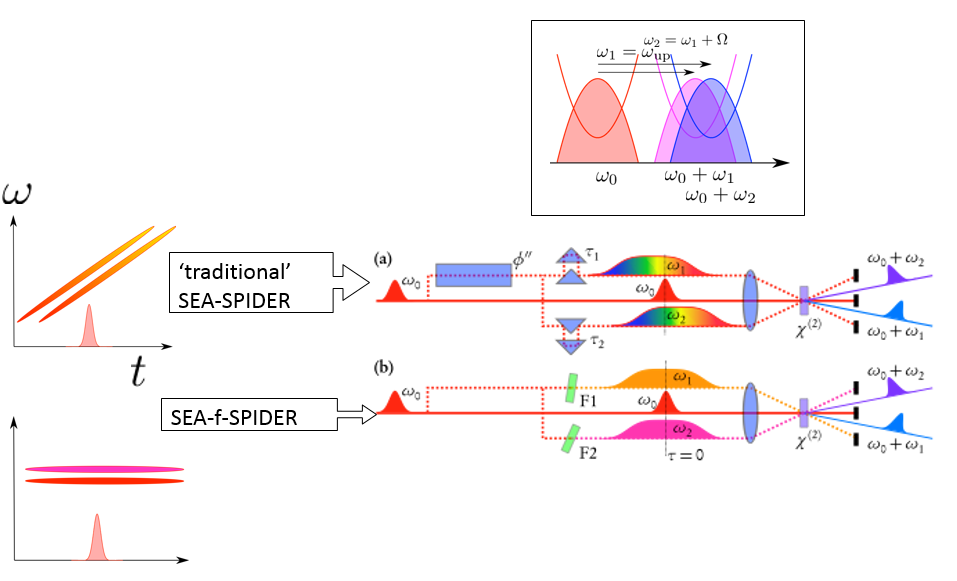
Instead of relying on a strongly chirped pulse (top) by e.g. stretching the unknown pulse in a long glass block or grating stretcher, filter-SPIDER employs direct spectral filtering. Using transmission bandpass filters leads to a very compact and easy to align experimental setup (bottom).
Relevant Publications:
Witting, Tobias, Dane R. Austin, and Ian A. Walmsley. “Improved Ancilla Preparation in Spectral Shearing Interferometry for Accurate Ultrafast Pulse Characterization.” Optics Letters 34, no. 7 (April 1, 2009): 881–83. doi:10.1364/OL.34.000881. link
Witting, Tobias, Dane R Austin, and Ian A Walmsley. “Ultrashort Pulse Characterization by Spectral Shearing Interferometry with Spatially Chirped Ancillae.” Optics Express 17, no. 21 (October 2009): 18983–94. link
Witting, T., S. J. Weber, J. W. G. Tisch, and J. P. Marangos. “Spatio-Temporal Characterization of Mid-Infrared Laser Pulses with Spatially Encoded Spectral Shearing Interferometry.” Optics Express 20, no. 27 (December 17, 2012): 27974–80. doi:10.1364/OE.20.027974. link